
Car Window
Tinting Perth
Fitted in an enclosed workshop, to Western Australia’s legal limits, with a compliance certificate on every vehicle.
- 30 years tinting
- Lifetime warranty
- Free quotes
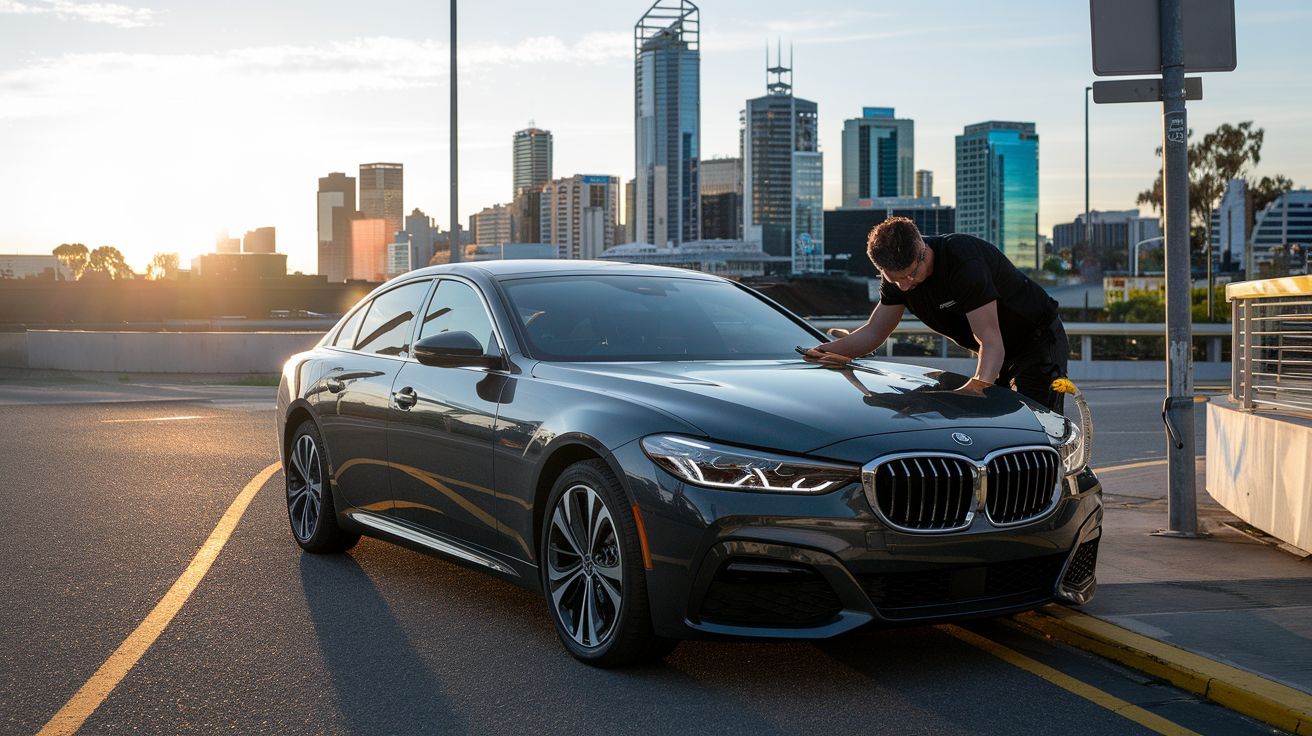
Is car window tinting worth it in Perth?
Yes, and the reason is your side glass rather than your windscreen. Your windscreen is laminated and blocks about 98% of UVA, but your side windows are tempered glass, which Cancer Council Australia says transmits UVA as high as 79%.
So the window you rest your arm on during a commute is the one doing least to protect you. Film changes that: clear or tinted film reduces total UV through tempered glass by over 99%, whatever shade you choose.
Heat is the other half. Perth’s mean maximum sits at 31.7°C in February, and on a 30°C day a car parked in the sun can reach 30 to 40°C above the outside air — most of it within the first five minutes. Film works on the cause instead of asking the air conditioning to catch up.
Cooler cabin
Less solar energy through the glass, so the car starts cooler and the air conditioning works less to hold it there.
UV protection
Over 99% of UV stopped at the side glass — the same on a light film as on a dark one.
Interiors last
UV is what cracks dashboards and fades upholstery. Blocking it protects the resale value of the car.
Less glare
Low morning and afternoon sun on a Perth commute is a real hazard. Film takes the edge off it.
Does a darker tint block more heat?
Barely. Moving from a near-clear film to the darkest film you are legally allowed on your front windows buys about fifteen percentage points of heat rejection — and no extra UV protection at all.
These are 3M’s published figures for its Crystalline range(Revision F, August 2025), measured on factory-tinted automotive glass.
| Film | Light through the window | Solar energy rejected | UV blocked |
|---|---|---|---|
| Near clear | 72% | 45% | 99.9% |
| Light | 64% | 51% | 99.9% |
| Medium | 48% | 56% | 99.9% |
| Darkest legal | 33% | 60% | 99.9% |
Read the last column first. Whether the film is nearly invisible or as dark as the law allows, UV rejection does not move. Darkness buys privacy and glare control. Heat rejection comes from the technology in the film, not from how dark it looks — which is why a good light film out-performs a cheap dark one.
We fit both LLumar and 3M films, so we match the film to what you actually want from it rather than to whatever is on the shelf.
What does car window tinting cost in Perth?
Car tinting is priced per vehicle rather than per window, because the work varies enormously between body shapes. A flat-glass ute is straightforward; a coupe with steeply raked rear quarter glass needs heat-forming and takes far longer.
What changes the price
- How many windows. Some people only want the rear half done.
- Which film. Ceramic sits well above carbon, and carbon above dyed.
- How curved the glass is. Curved glass needs heat-forming and takes longer.
- Whether old film has to come off first. That is a job in itself.
Ring us on (08) 9377 0677 with your make, model and year and we will give you a firm price rather than a range.
What is the darkest legal tint in WA?
Any window forward of the B pillar — your windscreen and front side windows — must let through at least 35% of visible light. Windows behind the B pillar can go down to 20% VLT on a passenger vehicle, provided the car has compliant external mirrors on both sides.
The windscreen cannot be filmed at all, apart from a band across the very top that sits above the area your wipers sweep and covers no more than 10% of the glass. These limits come from the Department of Transport’s Vehicle Safety and Standards Bulletin IB-119D, made under the Road Traffic (Vehicles) Regulations 2014.
Is 25% tint legal in WA?
Not on your front side windows. Behind the B pillar of a passenger vehicle, yes — 25% sits comfortably above the 20% floor. A car can be entirely legal with light film up front and much darker film behind, and that is the combination most Perth drivers choose.
Is 5% tint legal in Perth?
No, not on any window of a normal passenger car. Very dark film is permitted only on a short list of exceptions the bulletin names, such as stretched limousines and vehicles like ambulances and hearses. If a tinter offers you 5% all round on an ordinary car, they are offering you a defect notice.
Reflective and mirror-like films
Not permitted in Western Australia on any window. Reflectance is capped at 10%. If someone offers you a mirrored finish for a road-registered car, walk away.
How VLT is actually measured
VLT is measured through the glass and the film together, not the film on its own. Your factory glass already blocks some light before any film goes near it.
So a film sold as “35%” fitted to a car that already has slightly tinted glass can put the finished window under the legal limit — and it is the finished window that gets measured at a roadside check, not the film’s packaging.
We measure your factory glass before we quote. It is the only way to know what film keeps you legal, and it is why we will not quote a VLT figure over the phone without knowing your car.
Can I get a medical exemption for darker tint?
Yes, on medical grounds, but the application goes through the Department of Transport rather than through us. You will need documentary evidence from a medical specialist, and it is assessed by Vehicle Safety and Standards.
There is a second exemption worth knowing about if your car came with factory privacy glass darker than 20% VLT. The Department may permit film below 20% behind the B pillar so the tint matches the existing glass. That one is assessed case by case, and no exemption is ever granted for glass forward of the B pillar.
We are happy to talk you through what is involved, but we cannot grant an exemption ourselves, and neither can any other installer.
Ceramic, carbon or dyed?
Most of the price difference between quotes comes down to which of these three you are being offered. Ceramic rejects the most heat for a given darkness, carbon sits in the middle, and dyed film is the budget option that eventually fades.
Ceramic
Rejects the most heat for a given darkness, so you keep a lighter, legal tint and still get a noticeably cooler cabin. Contains no metal, so it will not interfere with your phone, GPS, radio or tyre pressure sensors.
It costs more. If your car sits outside all day, or you regularly carry kids or dogs, it is the one worth paying for.
Carbon or hybrid
Costs less than ceramic and gives a deep matte black finish with no purple fade. Heat rejection is lower than ceramic but well ahead of basic dyed film.
A sensible choice when appearance and privacy matter more to you than cabin temperature.
Dyed
The budget option, and it is what people mean when they talk about tint going purple. The dye breaks down under UV over time, which is why you see cars around Perth with windows faded to a patchy violet.
We can fit it, and we will tell you plainly what you are getting rather than sell it as something it is not.
We don’t tint cars in your driveway
We fit car film at our Bassendean workshop rather than on site, because the environment decides whether the tint still looks right in five years. A single speck of dust trapped under film becomes a permanent bubble that cannot be fixed without redoing the window.
Temperature while the adhesive sets determines how well it bonds, and surface preparation takes time that outdoor jobs rarely allow. None of that can be controlled in a driveway, a car park, or a verge on a windy Perth afternoon. It is the same reason panel shops do not spray cars in the open.
For homes and offices we do work on site right across Perth — see home window tinting and office window tinting. Cars are workshop only.
Recommended 900×700px.
Alt text: “Solarban WA’s enclosed car tinting workshop in Bassendean, Perth”
How long does car window tinting take?
Most cars take two to four hours, depending on how many windows you are having done and how curved the glass is. For most people it is a drop-off job rather than a wait-around one.
Book ahead where you can, particularly heading into summer — October through March is our busiest stretch, for obvious reasons.
Aftercare — the first five days
Leave your windows up for three to five days while the adhesive cures. This is the single most important thing you can do, and it is where most avoidable problems come from.
You may see slight haze, or small pockets of water that look like bubbles, during that period. That is normal and clears as the film dries — do not press it, pick at an edge, or take a squeegee to it.
After that, clean with a soft cloth and mild soapy water. Avoid ammonia-based glass cleaners, which break the film down over time.
Do you remove old or faded tint?
Yes. Old film that has gone purple, bubbled or started lifting at the edges has to come off completely before new film goes on, including all the adhesive residue underneath — which is the slow part of the job.
It is not worth attempting at home with a hairdryer and a scraper, particularly on a rear windscreen. Those have demister lines bonded to the glass, they are very easy to damage while scraping, and replacing a rear windscreen costs considerably more than having the film removed properly.
What warranty do you get?
Every Solarban WA installation carries a manufacturer backed lifetime warranty. It covers bubbling, peeling, cracking, adhesive failure and colour change for as long as you own the vehicle.
That is the film covered by the people who made it, not a promise that only stands as long as we do. The workmanship is ours and we stand behind that separately — if something is not right, bring the car back.
Do I get a certificate?
Yes. Every installation comes with a certificate recording the visible light transmission measured on each window, plus a compliance sticker on the glass.
Keep it. It is the document that answers the question if your tint is ever queried at a roadside inspection or during a vehicle transfer, and it is the reason we measure the finished window rather than trusting the number on the film’s packaging.
Where to find us
Our workshop is at 4/53 May Holman Drive, Bassendean WA 6054, with easy access off Guildford Road. We are a short run from Guildford, Ashfield, Bayswater, Eden Hill and Caversham, and a straightforward drive from Midland, Morley, Malaga, Belmont and the Swan Valley.
Customers come to us from right across the metro area — Perth CBD, Osborne Park, Joondalup and the northern suburbs, out to Ellenbrook, and down through Belmont and Victoria Park. If you are travelling from further afield, like Fremantle, Cottesloe or Rockingham, book a morning slot and make one trip of it.
- Address
- 4/53 May Holman Drive, Bassendean WA 6054
- Phone
- (08) 9377 0677
- nicola@solarbanwa.com.au
- Hours
- Mon–Fri 8am–4pm · Sat by appointment
- Since
- 1995
- ABN
- 35 619 289 511
Call us with your make, model and year
We will quote it properly. If you are not sure how dark you can legally go, bring the car in and we will measure your factory glass rather than guess.





